NovaQTech Insights
Why Quality Culture Matters More Than Quality Systems
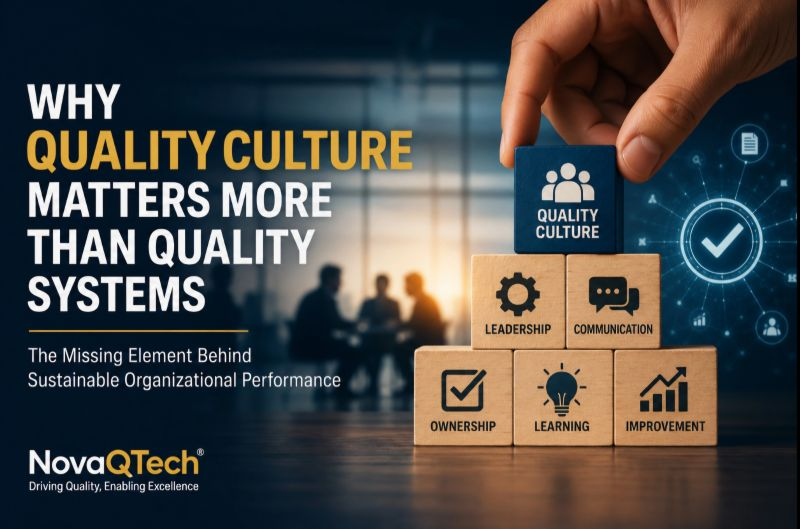
Many organizations invest heavily in management systems, certifications, audits, procedures, and compliance programs. Yet recurring nonconformities, customer complaints, poor communication, employee disengagement, and repeated corrective actions often continue.
The reason is simple: quality is not created by procedures alone.
A management system can define what people should do. A strong quality culture influences what people actually do—especially when nobody is watching.
Quality Systems Provide Structure, but Culture Shapes Behavior
Quality management systems are essential. They establish responsibilities, processes, controls, records, objectives, and methods for improvement. Standards such as ISO 9001 help organizations create consistency and accountability.
But a documented system cannot, by itself, guarantee honest reporting, thoughtful decisions, meaningful corrective action, or genuine ownership.
- A procedure can require employees to report problems. A quality culture encourages them to speak up without fear.
- A procedure can define responsibilities. A quality culture creates ownership.
- A procedure can require corrective action. A quality culture motivates people to investigate causes rather than close paperwork.
- An audit can identify nonconformities. A quality culture helps the organization learn from them.
The distinction matters because sustainable performance depends less on what an organization says in its documents and more on the behaviors it reinforces every day.
Why the Same Problems Keep Returning
Recurring problems are rarely caused only by missing procedures. More often, they reveal deeper cultural conditions:
- Employees do not feel psychologically safe enough to report concerns.
- Managers reward short-term results while ignoring process discipline.
- Corrective actions focus on symptoms instead of root causes.
- Departments protect their own targets rather than collaborating.
- Audits are treated as compliance events instead of learning opportunities.
- Lessons are documented but not shared or embedded in daily work.
When these patterns exist, adding more forms and instructions may increase administrative work without improving organizational performance.
What a Strong Quality Culture Looks Like
A quality culture exists when quality becomes a shared way of thinking and acting—not merely the responsibility of the quality department. It is visible when:
- Leaders respond constructively when problems are reported.
- Employees understand how their work affects customers and other processes.
- People challenge assumptions and raise weak signals early.
- Mistakes are examined for learning rather than hidden to avoid blame.
- Corrective actions address systemic causes.
- Improvement is part of normal work, not a campaign launched before an audit.
In such organizations, quality is not something performed for certification. It becomes part of organizational identity.
Leadership Is the Strongest Cultural Signal
Employees learn what truly matters by observing leadership behavior. If leaders ask only about delivery speed, cost, and output, employees quickly understand that quality is secondary—even when corporate policies say otherwise.
Leadership strengthens quality culture when it:
- Balances commercial pressure with customer and process risks.
- Welcomes difficult information instead of punishing the messenger.
- Participates visibly in learning and improvement.
- Provides resources for prevention, competence, and root-cause analysis.
- Uses performance indicators to ask better questions rather than assign blame.
Culture is shaped by repeated leadership choices. Every response to a reported issue teaches the organization whether transparency is genuinely valued.
Quality Culture in the Age of AI
Artificial intelligence can analyze large volumes of data, detect anomalies, identify patterns, and accelerate decisions. However, technology also magnifies the culture in which it operates.
In a weak culture, inaccurate data may be ignored, inconvenient findings may be suppressed, and AI recommendations may be accepted without sufficient judgment. In a strong quality culture, people question outputs, validate evidence, consider risks, and use technology responsibly.
As organizations adopt AI, they may need fewer repetitive controls—but they will need more critical thinking, openness, ethical judgment, and ownership. This makes quality culture more important, not less.
From Compliance to Sustainable Performance
Management systems provide structure. Technology provides capability. Culture provides sustainability.
The strongest organizations do not choose between systems and culture. They use systems to clarify expectations and culture to turn those expectations into reliable behavior.
A practical starting point is to ask:
- Can employees report problems without fear?
- Do leaders act consistently with stated quality values?
- Are recurring issues investigated as systemic signals?
- Do audits generate learning or merely evidence of compliance?
- Are improvement ideas recognized and acted upon?
- Does the organization discover important problems before they become failures?
This final question connects quality culture with a broader strategic capability: problem discovery. You can explore that relationship in our related article, Beyond PDCA and TQM: Why the Future of Quality Management Depends on Quality Culture and Problem Discovery Capability.
Conclusion
After more than two decades working with organizations across different industries, I have come to believe that one of the most overlooked factors in organizational success is not the quality management system itself, but the quality culture behind it.
Procedures remain necessary. Certification remains valuable. Audits remain important. But none of them can produce sustainable performance unless people trust the system, take ownership, communicate openly, learn continuously, and act before problems become failures.
Can an organization truly achieve sustainable performance without a strong culture of quality?
NovaQTech Group
Website: www.novaqtechgroup.com
Email: info@novaqtechgroup.com