NovaQTech Insights
Is Quality Management Entering a New Era? ISO, EFQM, and the Future of Integrated Excellence
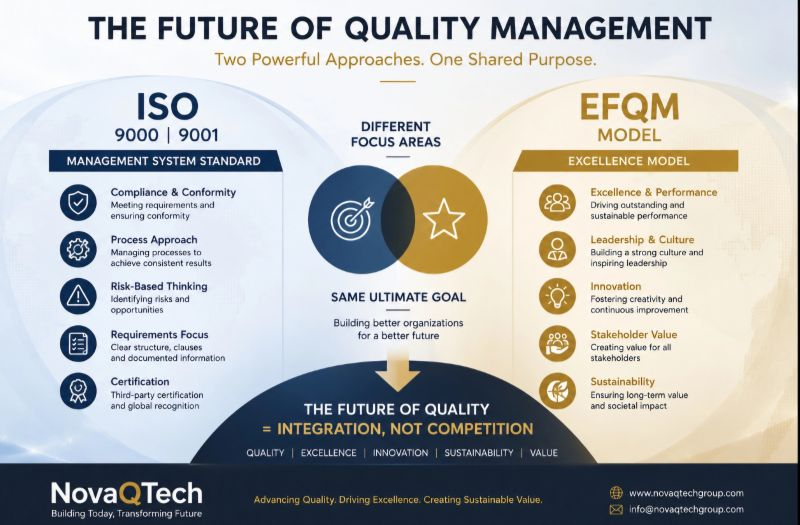
For many years, organizations have often viewed ISO 9001 and the EFQM Model as two separate approaches to organizational improvement. ISO was commonly seen as the management system standard for compliance, consistency, and certification. EFQM, on the other hand, was often positioned as a broader excellence model focused on leadership, culture, innovation, stakeholder value, and long-term performance.
Today, that separation is becoming less obvious. The language of modern quality management is changing. Organizations are no longer asking only whether their processes meet requirements. They are also asking whether their systems help them become more resilient, innovative, sustainable, and capable of adapting to a rapidly changing world.
From Compliance to Organizational Capability
The forthcoming revisions of the ISO 9000 family, particularly ISO 9000 and ISO 9001, appear to signal a broader direction for quality management. While compliance, process control, risk-based thinking, and documented information remain important, the future of quality is increasingly connected to organizational capability.
This means that quality management is no longer only about maintaining conformity. It is about helping organizations think, learn, improve, and perform in a more integrated way. A management system that simply documents activities may not be enough. The real question is whether the system enables better decisions, stronger leadership, more meaningful engagement, and sustainable results.
Where EFQM Has Been Strong for Many Years
The EFQM Model has long emphasized dimensions that are now becoming central to modern quality discussions. These include organizational culture, leadership maturity, innovation, stakeholder value, sustainability, and long-term performance. In many ways, EFQM has encouraged organizations to look beyond procedure and ask deeper questions about maturity, purpose, value creation, and transformation.
This is why the relationship between ISO and EFQM is becoming increasingly important. ISO provides a globally recognized framework for management systems. EFQM provides a holistic model for excellence and organizational maturity. When understood properly, these approaches do not need to compete with each other.
Different Routes, Similar Direction
One of the most important questions for quality professionals is whether ISO and EFQM are gradually moving toward the same philosophy from different directions. My perspective is that they are.
ISO continues to provide structure, discipline, consistency, and external recognition. EFQM continues to provide a broader lens for excellence, leadership, innovation, and sustainable performance. The future may not be about choosing one over the other. It may be about understanding how they complement each other in a practical management ecosystem.
Why Integration Matters Now
Organizations are operating in an environment shaped by artificial intelligence, digital transformation, organizational resilience, changing stakeholder expectations, and sustainability pressures. These forces are pushing management systems beyond traditional compliance thinking.
In this context, quality professionals may need to design integrated management ecosystems rather than isolated systems. Such ecosystems connect requirements, strategy, culture, risk, data, technology, people, and performance. They help organizations use quality not as a documentation exercise, but as a way of building capability and trust.
The Role of AI and Digital Transformation
AI and digital tools will likely accelerate this shift. Organizations will increasingly use data, automation, analytics, and intelligent systems to support decision-making and performance monitoring. However, technology alone will not create excellence. Without leadership, culture, ethical judgement, and system thinking, digital tools can simply automate weak processes.
This is where the combined logic of ISO and EFQM becomes valuable. ISO can help organizations define, control, and improve core processes. EFQM can help them assess maturity, leadership effectiveness, stakeholder value, and long-term direction. Together, they can support both discipline and transformation.
A New Role for Quality Professionals
The quality professional of the future may need to be more than a compliance specialist. The role may increasingly involve system design, organizational learning, digital readiness, stakeholder thinking, and strategic improvement. Quality professionals will need to understand standards, but also culture, leadership, data, innovation, and organizational behaviour.
This does not mean that compliance becomes unimportant. Compliance remains essential. But compliance should become the foundation, not the final destination. The real value of quality management is created when organizations use structure to build maturity, resilience, and sustainable performance.
Integration, Not Competition
The future of quality management may belong to organizations that can integrate the strengths of both approaches. ISO brings clarity, requirements, process discipline, and certification confidence. EFQM brings a broader excellence perspective, maturity thinking, and long-term value orientation.
For organizations seeking sustainable success, the question may no longer be: Should we use ISO or EFQM? A better question may be: How can we use both ways of thinking to build a stronger, smarter, and more future-ready organization?
This is a topic I am currently exploring in my ongoing research and upcoming publications. As quality management evolves, I believe the strongest organizations will be those that move beyond compliance and begin designing intelligent, integrated management ecosystems.
What do you think? Does the future belong to ISO, EFQM, or an intelligent integration of both?