NovaQTech Insights
Beyond PDCA and TQM: Why the Future of Quality Management Depends on Quality Culture and Problem Discovery Capability
For more than half a century, quality management has helped organizations improve products, services, processes, and customer satisfaction.
Frameworks such as PDCA, Total Quality Management (TQM), Lean, Six Sigma, Risk-Based Thinking, and Management System Standards have transformed how organizations operate.
These approaches remain highly valuable. However, the business environment has changed dramatically.
Organizations now operate in a world influenced by artificial intelligence, digital transformation, cybersecurity threats, supply chain disruptions, geopolitical uncertainty, sustainability expectations, regulatory complexity, and rapidly changing customer needs.
In this environment, simply improving existing processes is no longer sufficient. Organizations must first ensure that they are focusing on the right problems.
The Traditional Foundation
PDCA provides a structured method for improvement: Plan, Do, Check, Act.
TQM provides a philosophy that quality is everyone’s responsibility.
Together, PDCA and TQM have helped organizations reduce defects, improve efficiency, strengthen customer focus, and create cultures of continuous improvement.
Yet many organizations continue to improve processes that may no longer be strategically important. The issue is not a lack of improvement activity. The issue is a lack of clarity regarding what truly requires improvement.
The Missing Element: Quality Culture
Many organizations implement quality tools. Far fewer develop a true quality culture.
A quality culture exists when people openly report problems, challenge assumptions, share knowledge, learn from mistakes, and actively seek opportunities for improvement.
Without quality culture:
- Audits become compliance exercises.
- KPIs become reporting mechanisms.
- Corrective actions become paperwork.
- Improvement becomes reactive.
Quality culture transforms improvement from an organizational requirement into an organizational habit.
The Next Evolution: Problem Discovery Capability
Traditionally, quality management has focused on problem solving. Future quality management must place equal emphasis on problem discovery.
Problem Discovery Capability is the organizational ability to identify:
- Emerging risks
- Weak signals
- Hidden inefficiencies
- Changing customer expectations
- Strategic vulnerabilities
- New opportunities for value creation
Organizations that discover important problems early gain a significant competitive advantage. Organizations that discover them late are often forced into reactive improvement.
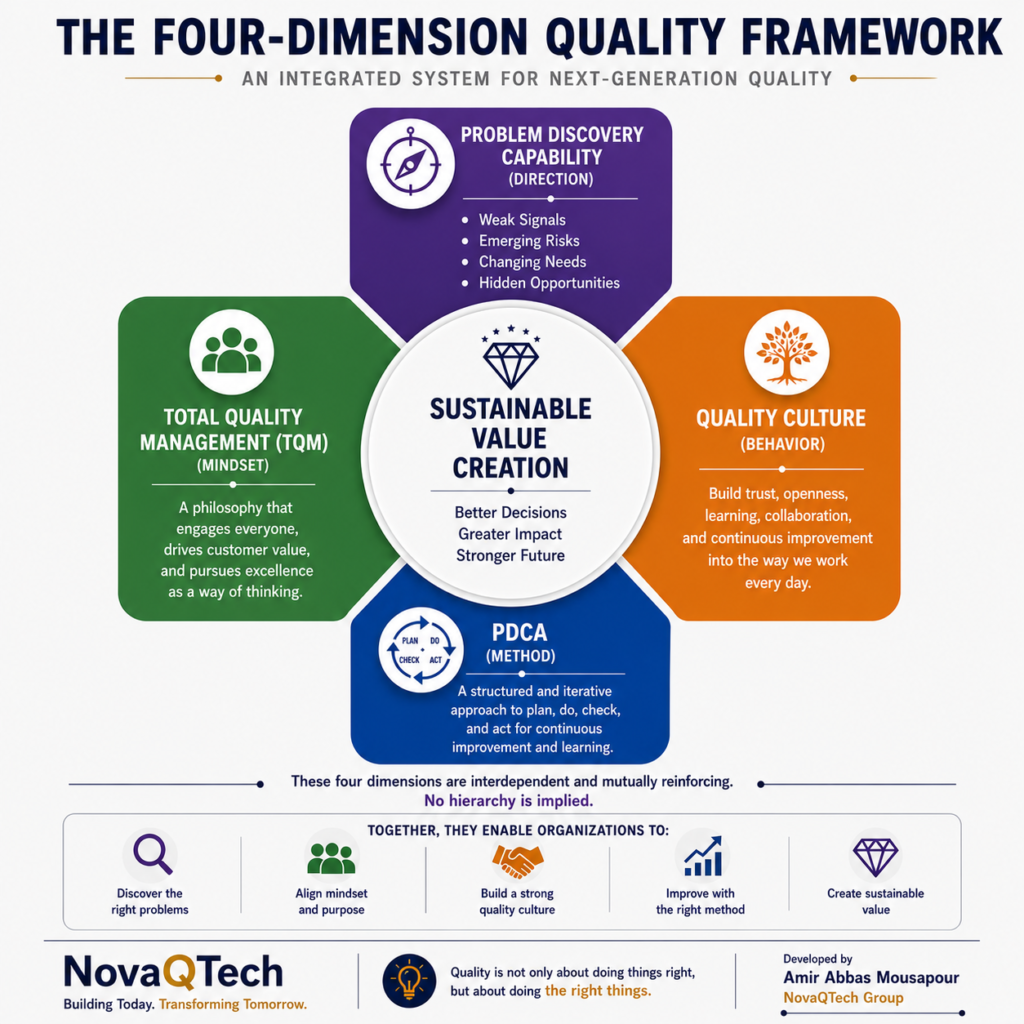
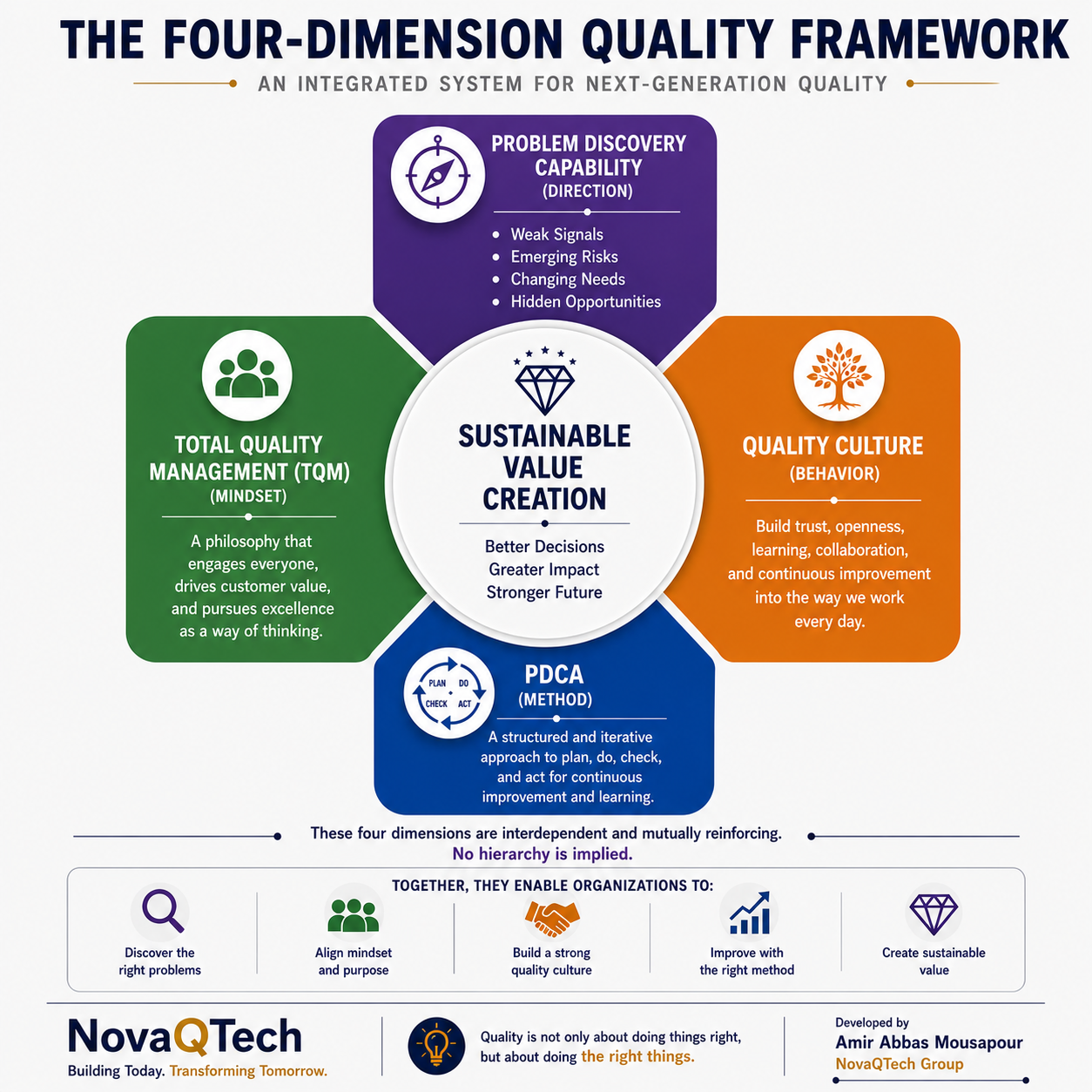
A New Quality Framework
In my view, the future quality model can be described as follows:
- PDCA = The Method
- TQM = The Mindset
- Quality Culture = The Behavior
- Problem Discovery Capability = The Strategic Direction
Together, these elements create sustainable organizational excellence.
The challenge is no longer only: How can we improve?
The more important question may be: What should we improve?
The Role of AI and Human Judgment
Artificial intelligence can help organizations analyze data, identify patterns, detect anomalies, and generate options.
However, AI does not fully understand organizational context, strategic priorities, stakeholder expectations, or long-term consequences. Human judgment remains essential.
The future belongs neither to humans alone nor to technology alone. The future belongs to organizations that effectively combine:
- Human judgment
- Quality culture
- Data intelligence
- Problem discovery capability
These capabilities help organizations make better decisions and create stronger long-term value.
Conclusion
For decades, organizations have focused on solving problems more effectively.
The next generation of quality management may require something even more important: the ability to discover the right problems before competitors do.
The future of quality is not only continuous improvement. The future of quality may be continuous discovery.